Historic step in the direction of combating pollution of the seas. In fact, according to Brussels and the European Commission, 80 percent of plastic pollution of the seas comes from plastic waste. On July 3, the Italian government will be asked to transpose the European “Single Use Plastics” directive.
Single-use plastics banned, or nearly so
Article 5 of European Directive 2019/904 of June 5, 2019 on reducing the impact of certain plastic products on the environment states that certain single-use plastic products that are easily dispersible in the environment will no longer be accepted on the market. This list of plastic products also includes oxo-degradable products. Conventional plastic products (PE, PP, PS, PET) added with substances that help their fragmentation under the effect of heat and UV light.
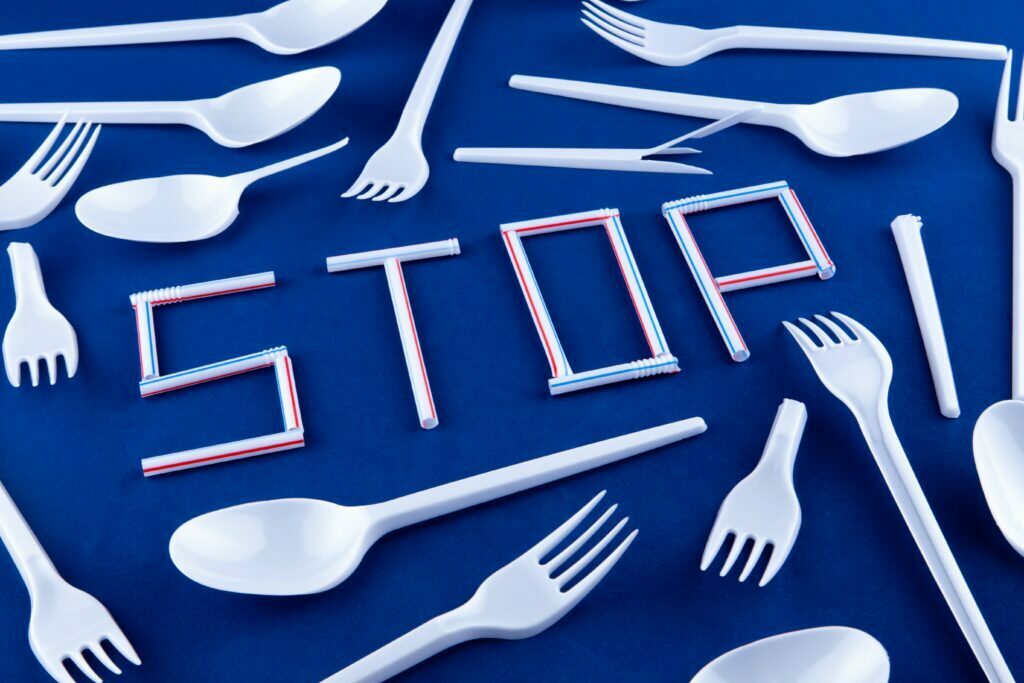
The list of products that will be banned is quite long:
- Q-tips,
- dishes,
- cutlery,
- straws,
- beverage mixers,
- Balloon rods,
- cups,
- Expanded polystyrene food and beverage containers.
A whole other set of disposable products, on the other hand, are affected by limiting and reducing their consumption. We are talking about fishing gear, bags, bottles, tobacco filters, sanitary ware, wet wipes, and polystyrene food and beverage containers. Here we will see the issuance of new labeling schemes and extended environmental responsibility for the producer following the “polluter pays” principle.

Each single-use plastic product, belonging to this second category, in fact, placed on the market must have on the packaging or on the product itself a marking in large, clearly legible and indelible characters that communicates to consumers the proper waste management methods for the product itself, the forms of waste disposal to be avoided, in line with the waste hierarchy, and the presence of plastic in the product and the consequent negative impact on the environment of dispersal or other improper forms of waste disposal.
Producers of single-use plastic products will also have to bear the cost of awareness-raising measures to inform consumers. They will also have to incentivize them to adopt responsible behavior to reduce:
- The dispersal of waste from these products,
- the costs of waste collection for such products delivered to public collection systems, including the infrastructure and its operation, and the subsequent transport and treatment of such waste;
- the costs of waste removal from such dispersed products and the subsequent transport and treatment of such waste.
An Italian problem
Italy is Europe’s leading plastics producer. The European UAS directive will certainly have an impact on industry and employment. These guidelines, in fact, close an entire industrial sector. Carlo Bonomi, current president of Confindustria, says that precisely because of the impact this directive could have on Italy’s industrial fabric, there could be mitigated adoption criteria.
The Italian line is built on two main points:
- the first concerns the EU’s failure to account for bioplastics, or biodegradable and compostable plastics, in disposable products;
- the second concerns the failure to recognize the sustainability of disposable products made of paper but covered with a thin polymer layer that makes them impermeable to liquids and grease.
To Brussels, however, these motions seem misplaced, and out of time, because the UAS Directive is two years old. Manufacturers find themselves unprepared today, despite this time of preparation. The marketing ban will not cover thin bags used for shopping and composting waste.
Bioplastics
According to the European Commission, moreover, the scientific evidence to say that plastics that are biodegradable in contact with air are quickly biodegradable even when immersed in water does not exist. This is the reason why the directive does not provide for differences in treatment between listed and banned single-use items, whether they are made from regular or biodegradable plastics.

As for glasses, cups and food containers made of paper but with plastic film, the directive does not ban these items immediately, as is the case for plastic forks and plates, for example. Instead, production and consumption of plastic-coated paper food containers, cups and bowls are to be subject to a progressive reduction, imposed by each member state, over the period 2022-2066. The reduction remains in place even if the production of these containers does not decrease, but their plastic-coated layer (which today is around 5-10 percent, by weight, of the final product) is thinned.